ECONOMY CONCLUSION

GROUP 1

Each group had seven topics to prepare and to present. We worked two days in group of twelve

people and did six posters, on which we collected the information of all the five countries.

We made diagrams to compare the differences between each country and wrote down possible

reasons and consequences for the results.

The group was splited in smaller work groups to work faster, because the groups were a little to big

in our opinion. We understood each other very good and had no problem with the language.

The first day was a little bit boring because we just collected the information.

That we had some excursions between the days of working in school was very good because we had

the chance do learn something about the spanish culture by real experiences.

We had to choose six posters which were the most interesting and than we had to conect them.

We found relations between them on another posters.

It was interesting that almost all of the topic were connected in some way and that there were

similarites and also differences between the countries.


1. SCHOOL DROPOUT-MEDIUM CULTURAL LEVEL

School dropout affects the medium cultural level.

-money, jobs, motivation, culture.

2. AGE OF EMANCIPATION-AGE OF REPRODUCTION

The sooner you moved out the sooner you'll have children.

-culture, economy, education(distance)

3.SCHOOL DROPOUT-LIFE EXPECTANCY

School dropout affects the income and lenght of life.

-If you got more money, the more you'll be able to take care of yourself.

-lower education, lower life quality.

4.SCHOOL DROPOUT-AGE OF REPRODUCTION-MEDIUM CULTURAL LEVEL

When women get pregnant they often drop school or to study to care for their children.


GROUP 2

As the second group we discussed minimum wage, average salary for basic, middle and higher education, average working day, holidays, retirement age, labour Right: Sick leave and maternity and unemployment and retirement

First we evaluated the data that each country prepared back at their own schools. We have observed some similarities and differences of each country's economy and concluded that economic conditions affect welfare level of countries. After drawing graphs for each topic, we have seen more clearly that all the topics are connected to each other.

When each group finished with their own topics, each group presented their posters to others, so that we had the chance to see what other groups have discuss. At the end of the presentation everybody rated their favorite three posters. Posters about medium cultural education, occupational accident, life expectancy, age of reproduction, school dropout, medium cultural level and age of emancipation are chosen as the best posters. After the voting each group made their own connections for the best posters. Our group thought that medium cultural education is the most important topic among the chosen posters. We believe that education is the key factor for the the economy and the welfare of the country.

To conclude it was a really informative activity, we got to learn more about the effects of economy on each country and had the opportunity to discuss these effects with people from other countries.


GROUP 3 


We are people from Denmark, Germany, Turkey, France and Spain. We met in Spain for the aim of seminar about economics and identities.
We made seven different posters about seven different topics. After that, we chose the best six posters and found the connection between them discussed about them.


We learned and compared that different factors of countries. Also, every topics that we investigated, are connected to each other. For example; medium cultural level will decrease or increase depending on the average of school dropout. Different factors take huge roles on each countries. That’s why, we got these results. There could be a lot of arrows but for us, these arrows are the most important ones.
It was an interesting experience to have information about the statistics of each country and compare those statistics.

ACTIVITIES


Youth Unmemployment- job and ID.


On the first day, Turquish, Danish and Spanish people met at 8.15 at Santa Ana church

to see the sunrise in Chiclana. Later we went to school and we all together ate churros with juice and also Spanish omelette. Then, we went to the Poeta’s gymnasium and we played some games in order to know each other better.

At the gym, we did four different teams of students from different countries. In the first game we have to learn our names so we have to said it and tell something that we love to do.

Then the second game was a “War of Tug”. The third game, all the members of the groups had to stay in the plynton for 3 seconds. In the fourth game, students were sitting in a line and they passed the two mats stretching their arms up and without letting the mat fall on the floor. Finally , the last game consisted in moving a pill of mats from one part of the gym to the other part. The team who did the game quickly won.

After the break time all of us have to work in the topics of each group since 14.30. In this time German people arrived at the school.

We really enjoyed the cooperative games. We learnt names, and it was a wonderful warning up. We all had lots of fun.


BREAKFAST


GAMES


DAY 2

Everybody met at school and then we walked to the Salinas of Chiclana, where we learned about the activitiy of collecting salt, about the animals and plants from the area and then we made some activities related with that subject. 


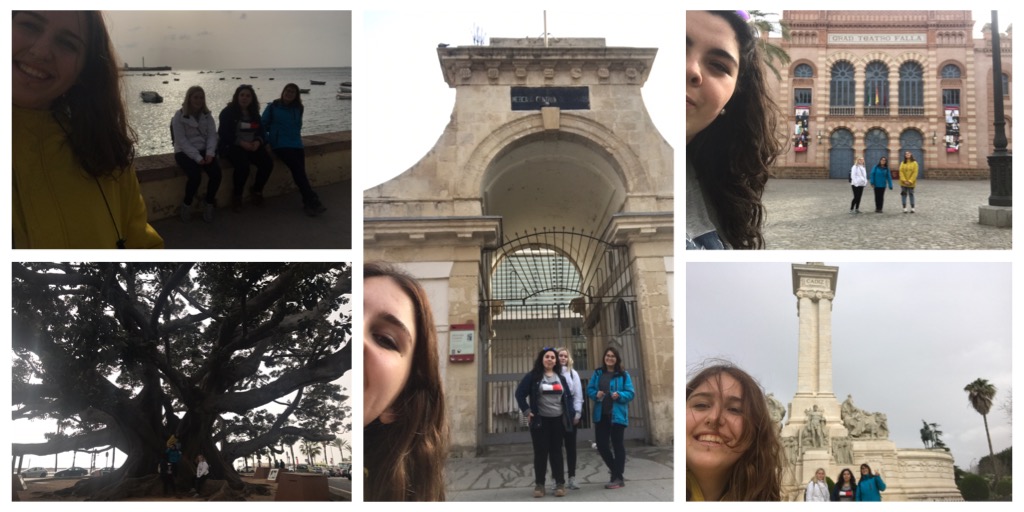
On the fourth day, we went to Cadiz at 9.00 where we first had the opportunity to enjoy a guided tour on the bus by a nice woman, (Luisa, who told us about some curiosities about Cadiz and its history.

We saw the new and the old town of Cadiz in about 30-45 minutes (it was pretty great considering Cadiz is really small). I found really interesting the fact that we have a lot of tropical plants which were brought from America centuries ago and they are still so healthy and beautiful.
Then, when we arrived at the port we got off from the bus and started walking around Cadiz where the woman told us a few intriguing stories. For example, why they built such a big monument as the one for the Constitution of 1812, or that we use cannons on the corners of the streets.

After a while, we went to the Museum and spent there other 30 minutes talking about the phoenician history because Cadiz was founded by them, we even saw what roman children used to play with (some little figurines of gladiators)

When we finished touring the museum, we had some free time to buy some food and have lunch and then the guide woman said goodbye to us and we got separated.

We walked to the town hall and waited there till our teachers told us what we had to do. We were free to do whatever we wanted to until 3.30 and then we met there to start the gymkhana.

In our free time, some of us went to the beach, others went shopping and everyone went to have lunch at some typical spanish restaurants.


Homepage


ERASMUS+ -National and local differencies - an inspiration for

 political action and active citienship.


SUPPORTED BY:

Resultado de imagen de erasmus plus


FIND MORE INFORMATION IN THE WEBSITE  ↑


Where we come from?


LONG-TERM EXCHANGE


Each year, two Spanish students have visited one of the other countries for two months. The students involved in the long-term exchanges were to make reports on their stays.

The idea was that the students from each of the countries involved had a common assignment. They had to brainstorm, to find materials, to take photos and to make interviews on the common project even though they were in different places, namely in each other’s countries. They should be better at seeing and understanding the foreign ways of living, because they could discuss it with their counterparts, who were foreigners in the opposite country.

In 2016-17 the topic was “Traditions”. The students brainstormed, made interviews and finally made a report on the differences between Spanish and Danish traditions.

In 2017-18 the main theme was “Participation and Democracy in the School” written in both Spanish and English.

EXHIBITION


Europe: Different countries, different cultures.


There was an exhibition of photographs from Denmark, Germany, Turkey, France and Spain. 50 photographs were exhibited. There were five topics: urban and natural landscapes, gastronomy, sports, culture and traditions. Each school had previously sent photographs related to these five topics with a description of each picture. Each picture had a title in English and Spanish below. Some flags of the five countries were held to draw people's attention on the European aim of the exhibition


The posters advertising the event were placed all over the town. (Cartel anunciador)


The opening was the 13th of March at six o´clock.


EUROPE: DIFFERENT IDENTITIES, DIFFERENT 

CULTURES


TURKEY


In November 2017 I had the opportunity to have an incredible experience, I was one of tte participants in an Erasmus Plus meeting in the educational Tevitöl, in Turkey. They have an International Baccalaureat (IB), for students between 16 and 19. This programme allows students to enter in an university without exam.

DENMARK

-TRAINING SEMINAR (Denmark, 25th September- 2nd October 2016)

Two teachers from IES Poeta García Gutiérrez High School (Lucía de Sarriá and Javier Palma) participated in a short term staff-training seminar in Denmark.It took place in Denmark from 25th September to 2nd October 2016. The topic we worked on was “Innovative teaching including ICT”.
All the participants were introduced to different types of ICT programmes. We were taught tools such as making a blog, a prezie and all sorts of quiz programmes.
We had the chance to participate in some lessons where ICT is a part of the teaching tools. We were also asked to make short manual/guides for our colleagues in Spain.
As a whole, we were definitely convinced of the benefits of using ICT tools in our lessons.
However, there is a big difference between Denmark and Spain. In Denmark, the use of computer was generalized since 2009. All the students bring their own labtop, and can access the school network via their computer. Mos of the work is digitally made via the computer, even assignments.
In Spain, even though the school uses a a school network (Moodle), only a few teachers use ICT tools. Moreover, students only bring their computers if they are required so.
We shared our teaching experiences with the other partner teachers and we enjoyed learning new techniques which surely will motivate our students. We really look forward to practise everything we learnt in the seminar.

RINGE


MY EXPERIENCE AT MIDFYNS GYMNASIUM BY A PARTICIPANT

We have atended a seminar in Denmark at Mydtfyns Gymnasium as part of an Erasmus Project aimed as “Differences, identity and active citizenship”. One of the aims of the seminar was to get to know how ICT teaching tools are used in class. 

I atended some English lessons and I also attended a History lesson. There are some learning procedures that we are not familiar with in Spain. I will explain them briefly .

Working in groups. I would say that in more than 50% of the lessons, students work in groups, the number of students in each group varies depending on the activity.I can say that students feel more comfortable when learning in such a way. I also makes quieter students get involved in the class.

Class management: I have noticed that students can be asked to leave the classroom if they have to do some group work( discussions, debates, different activities on grammar and vocabulary) and they enter the classroom once the activity is finished. The way the leave and enter the class is done in a quiet way.I think if you work in groups students find the lessons more amusing and at the same time they have the chance to meet students they wouldn´t meet if a more traditional class took place. The group generator(made through Notebook) is an effective way to organize the students in groups in a fast way.

Use of computers in class. Every student carry his/her computer to class because most of the lessons are carried out online.Every single classroom is provided with a smartboard, a good set of plugs to charge the devices and a traditional board. I haven´t seen a notebook or a pen in any of the clases I have attended, and I haven´t really missed them at all. 

Teacher training-This is a very important pont as far as the teaching process is concerned. I was told that teachers have training meetings and workshops every term. For that reason, University students come and are in charge of the students. Teachers arrange the lessons with the students.I find these seminars very useful, because it updates teachers with the latest teaching methods and techniques.In our country this would no be posible because during the school times we are engaged in many different tasks and (parents meetings, paper work, ground duties…) and there is no way we can find available time for us teachers to meet.

School atmosphere

Our students have been part of the school as normal students for a week and the first thing that they were most impressed at is the quietness and relaxing atmosphere you feel as you enter school. You can see students sitting on sofás, working with ipads…. In our schools, we try to make all students be inside the classrooms and ask them not to be wandering around.

Here in Denmark students can leave the classroom two or three times in a lesson if they are doing classwork and this is not very common in Spain because we don´t want to disturb other teachers.

It tools : I have been impressed at how teachers are so skilled at using the IT tools in class. I must add that every classroom is well equipped with Smart boards, computers and sound devices.

Visits. We did some visits besides the IT teaching. We were taken to a “After school” which is a boarding school where some students can go in between the secondary education and the gymnasium. It is based on an old system in which students are taught how to be independent and the curriculum is focused on áreas like music,art or drama. We also visited an assembly in a primary school. I liked the way school starts the day: singing, reflecting on some thoughts.


CHICLANA


The Spanish Seminar took place from 13th to the 17th , March , 2017 at IES Poeta Garcia Gutiérrez (Chiclana, Spain ). Students from five different countries met to work on job, employment and the impact on social and individual identity . Different activities such as cooperation games, cultural tours, workshops, seminars, exhibition, museum visits, and cultural games as well as cultural experiences were held during the week. Previously the students had exchanged information about themselves and they were given some assignments.

Throughout the week, a blog was prepared by two Spanish students on each aspect of the seminar and students from other countries contribute to and comment on it.


Gymkana in Cádiz


GROUP A

GROUP B


GROUP C


GROUP D


GROUP E
 
no video.

GROUP F


GROUP G


GROUP H


GROUP I 


GROUP J


GROUP K

RINGE - TRADITIONS

Turkish seminar

Turkish Seminar took place in January 2017. the main topic “traditions - constraints or inspiration for democratic action”.

The seminar was split into 2, half in Spain (Denmark, France and Germany), the other half in Denmark (Turkish, Spanish, French and German). There was importance on IT. We planned to , have video conferences between the 2 half conferences. We experienced more problems with this than we expected. The speed of the internet is very important. 

There were videos edited for each day, to be shown the following morning at both conferences see blog http://erasmusturkishseminar.blogspot.dk/. 

At the beginning of each conference there were warm up activities, to get the students to feel more comfortable working with each other and communicating well. Activities were started as a whole group, then students were separated into smaller groups, they worked together preparing posters and presentations. After which they presented them to the whole group. There were guests speakers to talk about religion and traditions. Children's games were played from each nation at both conferences. Long term exchange students reports and thoughts were shared and discussed. There was traditional dancing, shown and taught at both conferences. During the seminars students became aware that they are much more similar than they had previously thought. Even though there are clear differences in identities and traditions, and it is important to value and keep these, at the same time there are many things that are common between all groups that can increase tolerance and cooperation.

 Our objectives:

1) to make students more open minded 
2) Increase awareness of national similarities and differences 
3) helping improve their intellectual and maturing process 
4) Students become more tolerant of other cultures and less able people 
5) Make aware of differences and similarities in Language, religion, cuisine, dance, and national identity in general 
6) Use of ICT. 

Hereby our objectives were realized at these Turkish seminars .

KIEL


We never thought we were going to visit Kiel. Some of us have never heard about this city till it appeared as one of the partner site in the Erasmus programme.

Kiel is the capital of the northern German federal state of Schleswig-Holstein and with a population of approximately 250.000 inhabitants also its largest city. It is situated approximately 90 km north of Hamburg.

Kiel is well-known for a variety of international sailing events, including the annual Kiel Week at the end of June which is the biggest sailing event in the world.

From November 5th – 12th 2016 students from five different countries met at the THG school in Kiel, Germany to discuss the topic of “Sex and Gender” with its impact on social and individual identity. During this week, workshops, seminars, cooperation games, evening activities, and discussions
were organized around the topic.. The students became experts and multipliers and took home their acquired knowledge.

Students of the THG science-course prepared presentations on genetic disposition of sex, sexual orientation and disorders that served as an introduction to the main topic. The foreign students came

well prepared having accomplished the assignments to the seminar. Part of it was to find a general definition of the terms “sex” and “gender”, furthermore an introduction to genetics so that they were able to take part in the experiment of DNA isolation. Another homework-part included a questionnaire that was done as a survey in the home countries.

Finally, it was an enjoyable and interesting exchange and workshop.

BREST

Brest seminar took placed in may 2016. The topic was « Languages and Identity ». The students worked and the conclusions were :

Working on identity and languages in our different countries gave us the opportunity to understand the links between our countries history ,culture and traditions and the languages spoken .

Discovering how the former French colonies still use this language as a language of communication showed us the strenght of a language.

Discovering new languages like Chinese and Breton taught in the French School gave our students a view on new possibilities of communication.

Discussing on migrations and languages let us imagine that speaking different languages was an asset for this population.

Meeting a deaf person through a conference about deaf language and focusing on a universal language like Esperanto opened our students minds.

The final task ,the video which goal was to mix the languages studied and discovered during the week , gave the group the opportunity to practise them in a song performed on the stage.

TURKEY

TEV İnanç Türkeş Özel Lisesi in Gebze/Kocaeli, Turkey

DENMARK

 Midtfyns Gymnasium in Ringe, Denmark.

GERMANY

Thor-Heyerdahl-Gymnasium in Kiel, Germany

FRANCE

Groupe Scolaire de L'Estran in Brest, France

SPAIN

IES Poeta García Gutiérrez